PRE-PUBERTAL
TESTICULAR DERMOID CYST TREATED WITH CONSERVATIVE SURGERY
(
Download pdf )
LISIEUX E. JESUS, CLAUDIA R.R. PENA, ANA P.S. LEAO
Departments of Pediatric Surgery and Radiology, Hospital Municipal Jesus, Rio de Janeiro, RJ, Brazil
ABSTRACT
We present a case of testicular dermoid cyst that was treated with transinguinal excision of the testicular cyst with preservation of the healthy testicular parenchyma. We have reviewed the literature for clinical features and therapeutic approach in benign cystic tumors in the pre-pubertal testis.
Key
words: testis; benign neoplasms; dermoid cyst; infant
Int Braz J Urol. 2005; 31: 359-61
INTRODUCTION
The most common testicular tumors in children are teratomas with a predominance of benign lesions. Simple cysts and dermoid cysts are rare but uniformly benign, thus enabling surgery with gonadic preservation. It is important to recognize their clinical and radiological features so that the selected therapy implies minimal sequelae. We present one case of testicular dermoid tumor in an infant, which was surgically treated and with preservation of the healthy ipsilateral testicular parenchyma.
MATERIALS AND METHODS
A
5-month old patient was brought to our service for evaluating an increase
in scrotal volume that had been perceived some months earlier. He presented
normal male genitalia with increased volume of the left gland, which was
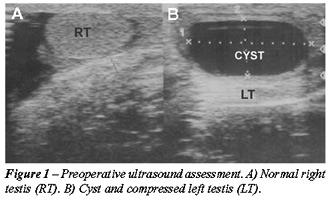
painless and regular with no transillumination. Ultrasound revealed a
left testicular cyst measuring 23 mm at its maximal diameter and a well-defined
and regular wall with no calcification, suggesting it was benign (Figure-1).
The patient returned when he was 10 months old, maintaining the same clinical
picture, with no increase in the lesion. A new ultrasound demonstrated
a left testicular cyst measuring 17 mm at its maximal diameter that was
causing parenchymal compression and atrophy. The affected testis was then
explored by inguinal access. We verified an increased volume of the gland
resulting from an ovoid cystic lesion, which was entirely intratesticular
(Figure-2). The lesion was regular and featured thickened walls and smooth
internal and external contours, and it measured 20 mm at its maximal diameter,
and was enucleated through compression of the spermatic cord using a longitudinal
anterior testicular incision with preservation of the surrounding testicular
parenchyma (Figure-2). The histological examination described a cystic
structure with typical squamous epithelium and fibrous connective external
wall amidst normal testicular parenchyma, compatible with a dermoid cyst
(Figure-2). After an 18-month follow-up, the patient remains asymptomatic,
the operated testis is topical and normal on palpation, with similar size
to the contralateral testis and normal parenchyma on ultrasound (maximum
diameter: 16 mm in right testis and 20 mm in left testis).

COMMENTS
Testicular
tumors are uncommon in pediatrics (1 case in 100,000 individuals per year),
with incidence peaks in infants and teenagers, and less than 1% of cases
are benign cysts (1). In infants, teratomas predominate. The literature
mentions approximately 300 cases of testicular dermoid cysts occurring
mostly in young adults (only 23 cases in children) (2). Recently, Metcalfe
et al. (3) have questioned these data, presenting 10% dermoid cysts among
testicular tumors in children aged up to 16 years in an institutional
sample of 51 lesions over 18 years.
Simple and dermoid testicular tumors clinically
manifest as an increase in scrotal volume and painless scrotal mass. Ultrasound
treatments of testicular dermoid cysts reveal typical properties, such
as regular cystic lesions whose content has variable sonographic features.
The lesion shows echogenic thickened walls, which can be viewed as internal
echoes with no acoustic enhancement, or as “onion-skin” patterns
caused by the accumulation of multiple layers of keratin debris, which
are avascular on Doppler image. Possibly the presentation is less typical
in younger patients due to the shorter progression time, with less marked
internal tumoral desquamation which, as seen in this case, makes differential
diagnosis with simple cysts difficult since the latter are characterized
by thin walls and anechoic regular content. Teratomas, which are typically
solid-cystic, can be exclusively cystic, and complex lesions with multiple
septations strongly suggest teratoma. Surgery is indicated in cases where
there is diagnostic uncertainty involving malignant tumors and for resolving
or preventing atrophy due to secondary compression by the cyst.
The traditional surgery for testicular tumors
is transinguinal orchiectomy. However, since the ‘90s, the predominance
of benign features among cystic testicular tumors in children and among
pre-pubertal testicular teratomas, as well as the demonstration of cases
with successful gonadic preservation and absence of malignancy in peritumor
biopsies from testicular dermoid cysts, have led several authors to indicate
simple inguinal enucleation of the tumor with compression of the spermatic
cord until its benign features have been confirmed (3). Histopathological
criteria include entirely intraparenchymal lesion with keratin debris,
fibrous external wall with squamous epithelial cells on the inside, no
evidence of mesodermal or endodermal tissue, and no abnormalities in the
remaining testicular parenchyma. The albuginea layer is sutured and the
gonad is returned to the scrotum. Some authors suggest that biopsies should
be made on adjacent parenchymal areas in order to exclude teratomatous
elements or “in situ” testicular carcinoma. When considering
the uniformly favorable results of simple enucleation, the use of the
inguinal access has been questioned since it is esthetically inferior,
and transcrotal surgery has been preferred. The limited experience, the
possibility of diagnostic error and the difficulty of analyzing the alpha-fetoprotein
values in children during the first semester of life have, for safety
and legal reasons, maintained the transinguinal access as the rule so
far.
_____________________________________
The authors acknowledge Dr. Leonardo Rizzo
and the pathology services of Jesus Municipal
Hospital and Antonio Pedro Hospital.
REFERENCES
- Ross JH, Rybicki L, Kay R: Clinical behavior and a contemporary management algorithm for pre-pubertal testis tumors: a summary of the Pre-pubertal Testis Tumor Registry. J Urol 2002; 168: 1675-8; discussion 1678-9.
- Neumann DP, Abrams GS, Hight DW: Testicular epidermoid cysts in pre-pubertal children: case report and review of the world literature. J Pediatr Surg. 1997; 32: 1786-9.
- Metcalfe PD, Farivar-Mohseni H, Farhat W, McLorie G, Khoury A, Bagli DJ: Pediatric testicular tumors: contemporary incidence and efficacy of testicular preserving surgery. J Urol. 2003; 170: 2412-5; discussion 2415-6.
_______________________
Received: January 26, 2005
Accepted after revision: May 26, 2005
_______________________
Correspondence address:
Dr. Lisieux E. de Jesus
Rua Presidente Domiciano 52 / 801
Niteroi, Rio de Janeiro, 24210-270, Brazil
E-mail: lisieux@uol.com.br