SERUM
PSA AND CURE PERSPECTIVE FOR PROSTATE CANCER IN MALES WITH NONPALPABLE
TUMOR
(
Download pdf )
MARCOS F. DALL’OGLIO, ALEXANDRE CRIPPA, CARLO C. PASSEROTTI, LUCIANO J. NESRALLAH, KATIA R. LEITE, MIGUEL SROUGI
Division of Urology, Paulista School of Medicine, Federal University of Sao Paulo, UNIFESP, Sao Paulo, SP, Brazil
ABSTRACT
Introduction:
Many studies have shown the association between PSA levels and the subsequent
detection of prostate cancer. In the present trial, we have studied the
relationship between preoperative PSA levels and clinical outcome following
radical prostatectomy in men with clinical stage T1c.
Materials and Methods: 257 individuals with
clinical stage T1c undergoing retropubic radical prostatectomy were selected
in the period from 1991 to 2000. Following surgery, biochemical recurrence-free
survival curves were constructed according to PSA levels between 0-4;
4.1-10; 10.1-20 and > 20 ng/mL.
Results: Of the total of 257 selected patients,
206 (80%) had Gleason scores from 2 to 6 and 51 (20%), presented Gleason
scores 7 and 8, as defined by the pathological report from prostate biopsy.
There was no biochemical recurrence of disease when the PSA was lower
than 4, regardless of Gleason score. Biochemical recurrence-free survival
according to PSA between 0-4; 4.1-10; 10.1-20 and > 20 was 100%, 87.6%,
79% and 68.8% for Gleason scores 2-6 and 100%; 79.4%; 40% and 100% for
Gleason scores 7-8 respectively. When all individuals were grouped, regardless
of their Gleason scores, the probability of biochemical recurrence-free
survival was 100%, 65.1%, 53.4% and 72.2% according to PSA between 0-4;
4.1-10; 10.1-20 and > 20 ng/mL respectively.
Conclusion: Non-palpable prostate cancer
presents higher chances of cure when the PSA is inferior to 4 ng/mL.
Key
words: prostate-specific antigen; prostatic neoplasms; prostatectomy;
treatment outcome
Int Braz J Urol. 2005; 31: 437-44
INTRODUCTION
Approximately
75% of men over 50 years old are screened for prostate cancer (PCa) by
testing the prostate-specific antigen (PSA) (1); among those with altered
PSA, two thirds will be identified as having PCa in stage T1c (2).
The indication for prostate biopsy when
the PSA exceeds 4 ng/mL should be assessed on an individual basis, especially
after recent data that showed PCa in 23.9 to 26.9% of men with PSA between
2 and 4 ng/mL (3).
One concern about the indiscriminate use
of PSA is the diagnosis of insignificant tumors (4) and the treatment
of eventual tumors with low biological aggressiveness. However, despite
the initial identification of PCa, 25 to 33% of individuals will die as
a consequence of the disease, though the majority is identified as T1c
(2). The detection of early PCa increases the chances of disease confined
to the prostate with lower risks of cancer recurrence following the treatment
(5), while some authors already believe that the disease-related mortality
is decreasing (6).
Due to the increasing debate concerning
the upper normal limits for PSA (7), this study aims to assess preoperative
PSA levels in individuals with PCa clinical stage T1c undergoing radical
prostatectomy, as well as their postoperative outcome.
MATERIALS AND METHODS
The
study assessed 257 men presenting a clinical diagnosis of PCa stage T1c,
with a mean age of 63.2 ± 7.5 years (47 - 76). The mean preoperative
serum PSA was 8.7 ± 5.6 ng/mL (0.3-32.0), and the mean postoperative
follow-up time was 85.4 ± 6.1 months. These were retrospectively
assessed.
The initial PSA was collected before prostate
biopsy. During staging, all patients underwent anamnesis and physical
examinations, alkaline phosphatase dosing, total and prostatic acid phosphatase,
pelvic computerized tomography and bone scintigraphy in order to rule
out extraprostatic disease.
All participants underwent retropubic radical
prostatectomies with bilateral pelvic iliac lymphadenectomy at our institution
from March 1991 to November 2000. The same surgeon (MS) performed all
surgical procedures and the same pathologist (KRL) performed all pathological
analyses.
Clinical staging was defined according to
the American Joint Committee on Cancer classification (8), and histological
grade according to Gleason score (9).
For selection of this group, cases receiving
neoadjuvant or adjuvant hormone therapy (14 patients), as well as adjuvant
radiotherapy (one patient), were excluded.
Postoperatively, patients were assessed
every 2 months during the first year, then every 6 months for 5 years,
and yearly from them on. During each assessment, patients underwent digital
rectal examinations of the prostate cavity and analysis of serum PSA.
Imaging exams (chest radiography, bone scintigraphy, abdominal tomography)
were repeated every year. Biochemical progression was defined as a serum
PSA higher than or equal to 0.4 ng/mL, a cut-off value that was used by
other authors as well (10).
The preoperative PSA was divided into categories
of from 0 to 4 ng/mL, 4.1 to 10 ng/mL, 10.1 to 20 ng/mL and higher than
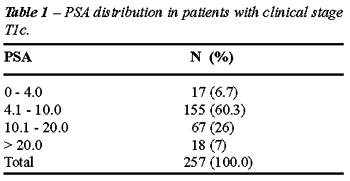
20 ng/mL. (The distribution of patients according to preoperative PSA
is in Table-1). Initially, we divided the patients into 2 groups: low
risk (Gleason scores 2-6) and high risk (Gleason scores 7-10). Subsequently,
we grouped all individuals together to build the survival curve.
For the statistical analysis, we used an
approach of survival analysis considering the biochemical recurrence of
the disease as the event of interest, defined by a PSA value higher than
or equal to 0.4 ng/mL. For the disease-free survival curves, we used the
Kaplan-Meier method and the Breslow and Log-Rank tests. A Cox regression
model with proportional risks was adjusted on the multivariate analysis.
P values < 0.05 were considered to be statistically significant.
RESULTS
Table-1
presents the distribution of 257 patients with clinical stage T1c showing
the incidence in relation to PSA values, where we can observe that 60%
of them had PSA between 4.1 and 10.0.
Table-2 presents the 206 patients with clinical
stage T1c and Gleason scores of 2-6 (low risk) in relation to PSA levels
and events in relation to the assessed PSA categories. In Figure-1, we
can see that PSA levels influenced the disease-free survival rates of
patients with clinical stage T1c (p = 0.008). We can also observe that
none of the patients with PSA between 0 and 4.0 presented a recurrence
of disease during the assessment period. When PSA levels oscillated between
4.1 and 20 ng/mL, they showed the same prognosis (p = 0.102) in relation
to the expectancy of biochemical recurrence-free survival.
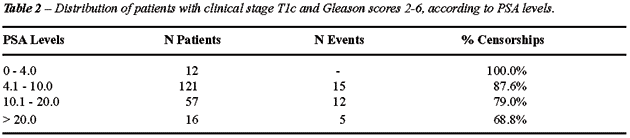
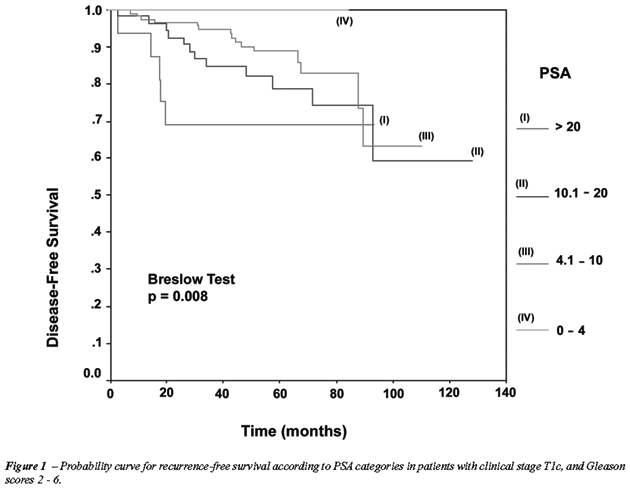
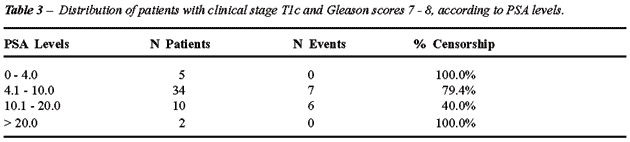
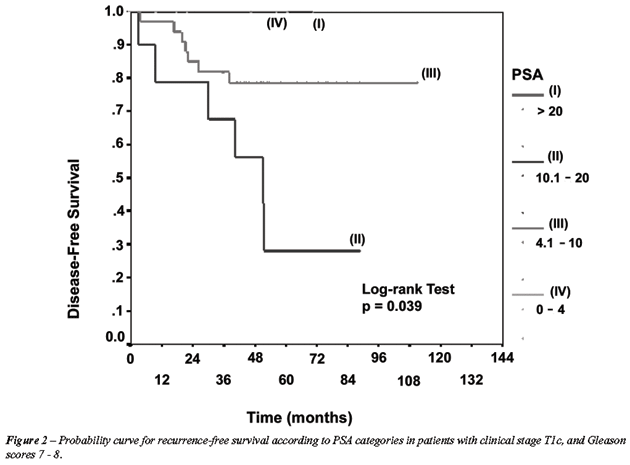
Table-3 represents the distribution of 51
patients with clinical stage T1c and Gleason scores of 7 and 8 according
to PSA levels. It is important to stress that there was no patient with
a Gleason score of 9 or 10. The survival probability curve for biochemical
recurrence of disease according to PSA categories for patients with clinical
stage T1c, Gleason scores 7 and 8 (Figure-2) show statistical significance
(p = 0.039), when comparing PSA levels < 4 ng/mL, 4.1-10 ng/mL and
10.1-20 ng/mL. Only 2 patients had Gleason 7-8 and PSA > 20 ng/mL;
however, they did not present recurrence of disease. These particular
individuals had a follow-up of 19.5 months. Moreover, both specific individuals
had PSA values of 21 ng/mL and 23.5 ng/mL.
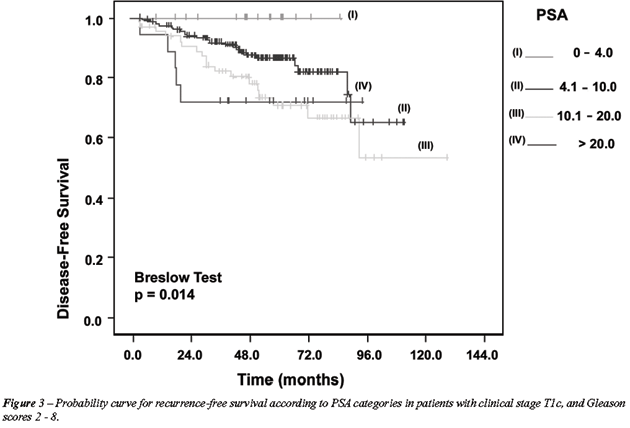
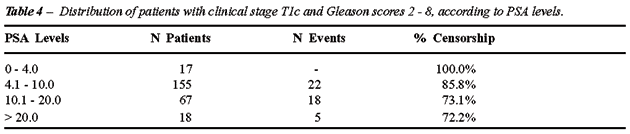
Finally, we constructed a graph (Figure-3)
which groups all individuals, regardless of Gleason score, which is summarized
in Table-4. In addition to the absence of biochemical recurrence with
PSA < 4 ng/mL, even after a median follow-up of 85.4 months, it is
important to stress that, for individuals with PSA 4.1 to 10.0 ng/mL after
89.1 months, the probability of remaining free of biochemical recurrence
is 65.1%. For patients with PSA of 10.1 to 20.0 ng/mL, after 92.6 months
the probability of being free of biochemical recurrence is 53.4%. Finally,
in men with PSA > 20.0 ng/mL, the probability of being free of biochemical
recurrence is 72.2%; however, in this particular group, we stress that
the median follow-up was substantially shorter – only 19.5 months.
COMMENTS
The
study demonstrated that the life expectancy free of biochemical recurrence
in individuals with PCa clinical stage T1c and undergoing radical prostatectomy
is higher in those with PSA inferior to 4.
From 1986 and 1999, the use of PSA for screening
has reduced the incidence of metastatic PCa from 50 to 70% (11). Considered
more lethal than cardiac disease for between 60 and 80 year olds, the
PCa is currently diagnosed in its localized form in 86% of men (12). Additionally,
pathological changes of the prostate are identified during autopsies in
64% of men aged between 60 and 70 years of age (13).
The assessment of PSA for screening PCa
has enabled an early diagnosis and treatment of the disease. This statement
can be corroborated by one study, which compared men with PCa clinical
stage T1c and PSA between 2.6 and 4 ng/mL, and individuals with PSA between
4.1-10 ng/mL (5). The study demonstrated that in the first group there
are higher chances of organ-confined disease and lower tumor volume.
Johansson et al. (14) showed that observation
could be dangerous to men with a life expectancy of over 10 years, demonstrating
that after 15 years under a surveillance regimen the cancer-specific mortality
increased from 15 to 44/1000, progression-free survival dropped from 45%
to 36%, metastasis-free survival decreased from 76.9% to 51.2% and cancer-specific
survival dropped from 78.7% to 54.4%. These figures confirm that a long
follow-up is required in PCa so that the benefits of early diagnosis and
treatment can be observed. Additionally, the probability of death due
to disease progression after 15-year surveillance increases from 4 to
30% with Gleason scores of 2-6 and 42 to 87% for Gleason scores of 7-10
(15).
In individuals under a surveillance regimen,
the need for treatment was confirmed in 57% and 73.2% after 2 and 4 years
respectively, with an increase in Gleason score in 24% of men after 3.8
years (16).
It is possible that non-palpable prostate
tumors evidence significant disease, since this study has revealed a 12.4%
chance of biochemical recurrence in individuals with PSA from 4.1 to 10
ng/mL and 21% when PSA are between 10.1 and 20 ng/mL, in spite of stage
T1c even in low risk tumors, with Gleason scores of 2-6. On the other
hand, when we group all individuals regardless of Gleason score, the expectancy
of biochemical recurrence-free survival remains at 100% when PSA <
4 ng/mL and decreases drastically to 65.1 % and 53.4 % when the PSA is
4.1 - 10 and 10.1 - 20 ng/mL respectively.
When analyzing Figure-2, for PSA levels
of 4.1-10 ng/mL and 10.1-20 ng/mL, it is important to stress that the
biochemical recurrence-free survival drops from 79.4% to 40% when only
the Gleason score 7-8 is assessed, however it is 100% both in individuals
with PSA lower than four and in the two patients with PSA higher than
20 ng/mL. However, when all individuals are grouped (both low and high
risk tumors as represented in Figure-3), the apparently contradictory
probability of biochemical recurrence occurring in 72.2% of men with PSA
> 20 ng/mL is broken down – especially if we observe that in
those particular cases the follow-up lasted only 19.5 months. Probably
this percentage will decrease with evolving follow-up.
The need for surveillance in men between
the fifth and the sixth decades of life should be considered. Some authors,
by the way, advocate the performance of prostate biopsy establishing a
PSA value up to 2.6 ng/mL as the upper normal limit (8) for men aged less
than 60 years of age (11).
Since the classical concept by Whitmore
(17) about the paradox existing in the treatment of PCa (is cure required
when it is possible, or is it possible when it is required?), with the
wide use of PSA in screening and the dramatic increase in the detection
of organ-confined disease, the concept of clinically significant disease
has become very important due to the risk of over treating the PCa. The
main studies comparing radical prostatectomy with a surveillance regimen
have been initiated in order to answer these questions. The Scandinavian
prospective randomized study (6) assessing the development of metastasis
in localized PCa has shown that metastases occurred in 13.4% and 27.3%
for the surgery and the surveillance regimen groups respectively; in the
untreated group the risk of metastases was 37% higher than in the group
undergoing surgery with a median follow-up of 6 years. The risk of death
after 8 years was 7.1% and 13.6% for the surgery and the surveillance
regimen groups respectively; after a 10-year follow-up the risk of death
increases to 16.8% in untreated men.
The concern to avoid over treatment in men
with PCa should be carefully considered, however, the majority of T1c
tumors are already significant tumors; that is, they present one of the
following features on biopsy: Gleason patter 4, = 3 positive fragments
on biopsy and a fragment more than 50% affected by tumor (18). Carter
et al. (19) obtained 31% of progression of disease during the first year
of surveillance regimen in low risk tumors on the initial biopsy; that
is, absence of primary Gleason pattern 4/5, < 3 positive fragments
/12, no fragment more than 50% affected and PSA density of < 0.15).
With the possibility of over treating the
PCa, currently 25% of men undergoing radical prostatectomy require a second
therapy during the first 5 years following surgery (20). This figure begs
the question of the correct PSA value that should be considered normal
for each individual.
In order to illustrate the great dilemma
concerning PCa screening, we need to evaluate the following situation:
in Brazil, according to data from the Ministry of Health in 2005, there
are approximately 23 million men between 40 and 79 years old. Among these
men, and if we apply the worldwide statistics to our country, approximately
92% of men have PSA < 4 ng/mL. Of those 8% of individuals with PSA
> 4, we will find 25% or 500,000 men with PCa. These figures are, to
say the least, disturbing.
This study has some limitations, since it
is retrospective and the digital rectal examination can be subjective.
On the other hand, we considered as a positive factor the fact that it
as a homogeneous group with follow-up longer than 7 years, which was assessed
and operated on by the same surgeon.
We must make every effort to understand
the natural history of prostate cancer, which is often unpredictable,
and try to find the best moment for indicating prostate biopsy based on
PSA.
CONCLUSION
With the acknowledgement of limitations in accuracy for identifying men with small volume cancer prostate, the attitude of avoiding biopsy can delay the diagnosis and result in losing the opportunity to cure.
Adriana Sañudo performed the statistical analysis
REFERENCES
- Sirovich BE, Woloshin S, Schwartz LM: Screening men for prostate and colon cancer: are priorities in order? J Gen Intern Med. 2002; 17 (Suppl. 1): 212.
- Cooperberg MR, Lubeck DP, Meng MV, Mehta SS, Carroll PR: The changing face of low-risk prostate cancer: trends in clinical presentation and primary management. J Clin Oncol. 2004; 22: 2141-9.
- Thompson IM, Pauler DK, Goodman PJ, Tangen CM, Lucia MS, Parnes HL, et al.: Prevalence of prostate cancer among men with a prostate-specific antigen level < or =4.0 ng per milliliter. N Engl J Med. 2004; 350: 2239-46. Erratum in: N Engl J Med. 2004; 351: 1470.
- Stamey TA, Freiha FS, McNeal JE, Redwine EA, Whittemore AS, Schmid HP: Localized prostate cancer. Relationship of tumor volume to clinical significance for treatment of prostate cancer. Cancer. 1993; 71 (Suppl 3): 933-8.
- Krumholtz JS, Carvalhal GF, Ramos CG, Smith DS, Thorson P, Yan Y, et al.: Prostate-specific antigen cutoff of 2.6 ng/mL for prostate cancer screening is associated with favorable pathologic tumor features. Urology. 2002; 60: 469-73; discussion 473-4.
- Stephenson RA: Prostate cancer trends in the era of prostate-specific antigen. An update of incidence, mortality, and clinical factors from the SEER database. Urol Clin North Am. 2002; 29: 173-81.
- Hernandez J, Thompson IM: Prostate-specific antigen: a review of the validation of the most commonly used cancer biomarker. Cancer. 2004; 101: 894-904.
- Beahrs OH, Henson DE, Hutter RVP: American Joint Committee on Cancer Manual for Staging Cancer. 4th Ed, Philadelphia, JB Lippincott. 1992.
- Gleason DF: Histologic Grading and Staging of Prostatic Carcinoma. In: Tannenbaum M (ed.), Urologic Pathology. Philadelphia, Lea & Febiger. 1977; pp. 171-87.
- Ward JF, Blute ML, Slezak J, Bergstralh EJ, Zincke H: The long-term clinical impact of biochemical recurrence of prostate cancer 5 or more years after radical prostatectomy. J Urol. 2003; 170: 1872-6.
- Carter HB: Prostate cancers in men with low PSA levels—must we find them? N Engl J Med. 2004; 350: 2292-4.
- Jemal A, Tiwari RC, Murray T, Ghafoor A, Samuels A, Ward E, et al.: Cancer statistics, 2004. CA Cancer J Clin. 2004; 54: 8-29.
- Sakr WA, Grignon DJ, Crissman JD, Heilbrun LK, Cassin BJ, Pontes JJ, et al.: High grade prostatic intraepithelial neoplasia (HGPIN) and prostatic adenocarcinoma between the ages of 20-69: an autopsy study of 249 cases. In Vivo. 1994; 8: 439-43.
- Johansson JE, Andren O, Andersson SO, Dickman PW, Holmberg L, Magnuson A, et al.: Natural history of early, localized prostate cancer. JAMA. 2004; 291: 2713-9.
- Albertsen PC, Hanley JA, Gleason DF, Barry MJ: Competing risk analysis of men aged 55 to 74 years at diagnosis managed conservatively for clinically localized prostate cancer. JAMA. 1998; 280: 975-80.
- Carter CA, Donahue T, Sun L, Wu H, McLeod DG, Amling C, et al.: Temporarily deferred therapy (watchful waiting) for men younger than 70 years and with low-risk localized prostate cancer in the prostate-specific antigen era. J Clin Oncol. 2003; 21: 4001-8.
- Whitmore WF Jr, Warner JA, Thompson IM Jr: Expectant management of localized prostatic cancer. Cancer. 1991; 67: 1091-6.
- Epstein JI, Walsh PC, Carmichael M, Brendler CB: Pathologic and clinical findings to predict tumor extent of non-palpable (stage T1c) prostate cancer. JAMA. 1994; 271: 368-74.
- Carter HB, Walsh PC, Landis P, Epstein JI: Expectant management of non-palpable prostate cancer with curative intent: preliminary results. J Urol. 2002; 167: 1231-4.
- Lu-Yao GL, Potosky AL, Albertsen PC, Wasson JH, Barry MJ, Wennberg JE: Follow-up prostate cancer treatments after radical prostatectomy: a population-based study. J Natl Cancer Inst. 1996; 88: 166-73.
____________________
Received: June 6, 2005
Accepted after revision: August 17, 2005
________________________
Correspondence address:
Dr. Marcos F. Dall’Oglio
Rua Barata Ribeiro, 398 / 501
São Paulo, SP, 01308-000, Brazil
Fax: + 55 11 3159-3618
E-mail: marcosdallogliouro@terra.com.br